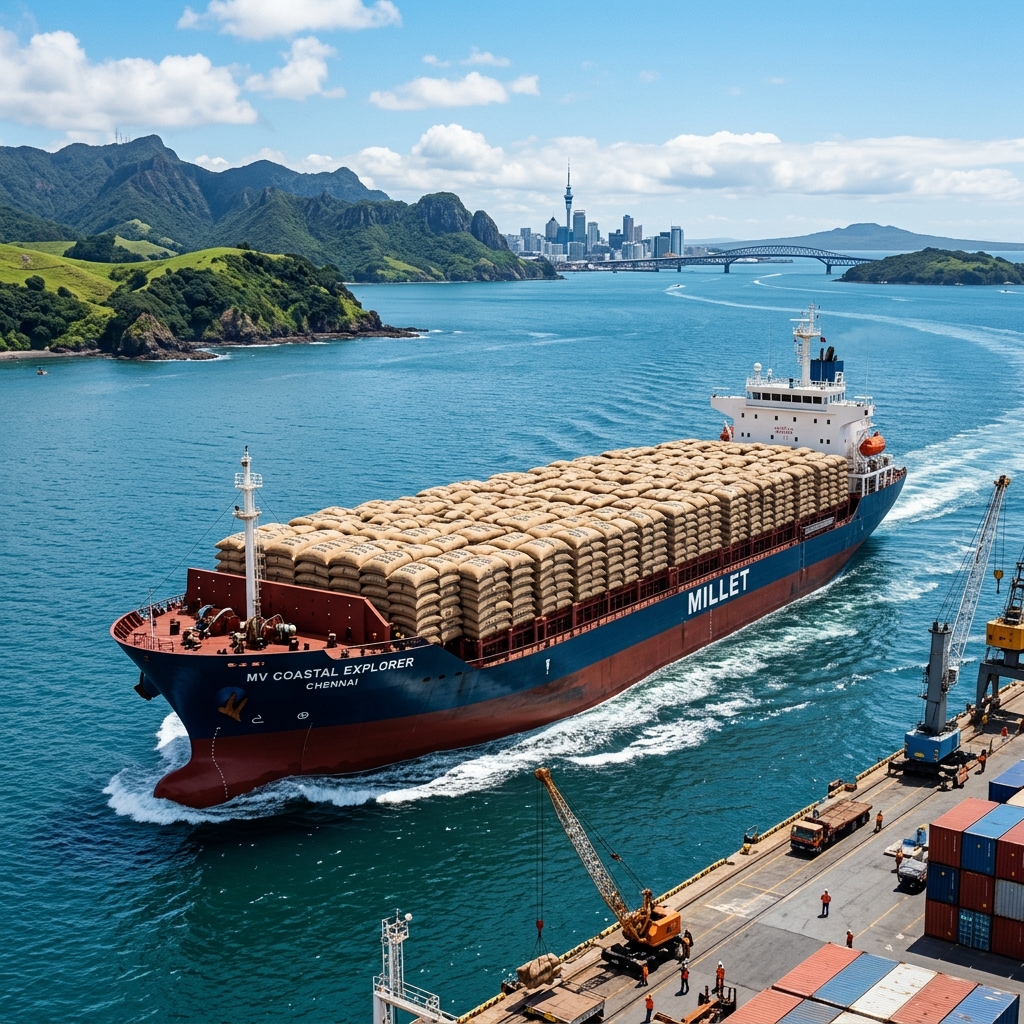
A One-Tonne Shipment That Means More Than Its Weight
On June 3, 2026, APEDA facilitated the first-ever sea shipment of ready-to-cook millet functional foods from Karnataka to New Zealand. The consignment was only one metric tonne — sent by a Bengaluru-based exporter — but every new trade corridor starts somewhere, and this one matters for buyers paying attention to where Indian millets are heading next.
Every so often a small piece of trade news tells you more than a big market report does. This is one of those moments. The fact that a sea shipment was the chosen mode — not air freight — signals that this is being positioned as a commercially viable, scalable trade route, not just a promotional one-off.
1. Why New Zealand? Why Now?
New Zealand is not an obvious first choice when most exporters think about millet destinations. The market is small by volume standards. But here is what makes it significant:
- Health-conscious consumer base: New Zealand has one of the highest per-capita spends on health and wellness food in the Asia-Pacific region. Gluten-free, ancient grain, and low-GI products have strong retail demand there.
- Gateway to broader Pacific markets: A successful trade corridor into New Zealand often opens adjacent markets — Australia, Fiji, and Pacific Island states follow similar import and consumer patterns.
- Regulatory alignment: New Zealand food safety standards (MPI) are rigorous but well-understood. An exporter who clears MPI requirements once has a template for other OECD markets.
- Diaspora demand: A significant South Asian and Indian diaspora in Auckland and Wellington creates ready initial demand for familiar millet-based food products.
2. What Was Actually Shipped?
This was not raw grain. The consignment consisted of ready-to-cook millet functional foods — value-added, processed millet products. That distinction is important for buyers to understand:
| Category | Raw Millet Grain | Ready-to-Cook Millet Foods |
|---|---|---|
| Processing | Sortex cleaned, graded | Milled, blended, packaged |
| Value per MT | Lower (commodity price) | Higher (branded / retail margin) |
| Target buyer | Flour mills, food processors | Retailers, FMCG brands, distributors |
| Shelf appeal | Industrial / bulk | Consumer-ready, brandable |
Indian exporters are increasingly moving up the value chain. This shipment is evidence that the industry is not just selling grain — it is selling formulated food products that a retailer can stock directly. Buyers who source now get access to that pipeline early.
3. What This Means for International Buyers in 2026
At SNS Global Traders, I track these market signals carefully because they tell us where the next reliable sourcing opportunities are forming. Here is what I read into this shipment:
Sea Freight is Viable
The choice of sea over air freight means per-unit economics work at commercial scale. This is not a sample — it is the start of a shipping lane.
APEDA Certification Travels
APEDA-certified exporters have the documentation infrastructure to satisfy even strict Western import markets. Buyers can rely on consistent quality assurance.
New Markets Are Opening
After the Middle East and North America, the Asia-Pacific is the next frontier. Buyers entering now establish relationships before competition increases.
Private Label Opportunity
Ready-to-cook formats are ideal for private label buyers who want a branded product without building their own processing supply chain.
4. What Indian Millet Exporters Need to Do to Serve These Markets
New trade corridors like the New Zealand route do not succeed by accident. They require the exporter to be prepared on several fronts simultaneously:
- Regulatory documentation: Phytosanitary certificates, fumigation records, country-of-origin declarations, and MRL (Maximum Residue Level) test reports for the destination market.
- Consistent product quality: Buyers in developed markets have zero tolerance for quality variation. Sortex-cleaned grain with moisture below 12% and contaminant-free processing is the minimum standard.
- Shelf-ready packaging: For retail destinations, products need proper retail-grade packaging with correct labelling, nutritional information, and local language compliance where required.
- Reliable supply volume: Starting with one tonne is fine for a pilot, but buyers need assurance that a commercial-scale reorder — 10 to 24 metric tonnes — can be fulfilled without disruption.
At SNS Global Traders, we have built our export operations specifically to meet these standards across all the above requirements, whether the buyer is in the UAE, the USA, or, increasingly, the Asia-Pacific.
Source Indian Millets with SNS Global Traders
We are an APEDA registered exporter (RCMC Certified), FIEO member, and IEC holder based in India. We supply 99.5% Sortex-cleaned, moisture-controlled Finger, Pearl, Foxtail, Kodo, Barnyard, and Browntop millets — in both raw grain and processed formats — packed in 25kg/50kg PP bags or 20ft FCL container loads (~24 Metric Tons).
Whether you are entering a new market like New Zealand or scaling an existing distribution channel, we provide buyers with a free 500g physical sample kit and full laboratory analysis before any commitment.
Request a Sample or QuotationData Sources & Official References
- • APEDA (Agricultural and Processed Food Products Export Development Authority) — First Sea Shipment Facilitation Announcement, June 2026
- • Indian Brand Equity Foundation (IBEF) — Millet Export Sector Update 2026
- • Ministry of Commerce & Industry, Government of India — Shree Anna Export Promotion Initiative
- • New Zealand Ministry for Primary Industries (MPI) — Food Import Health Standards
